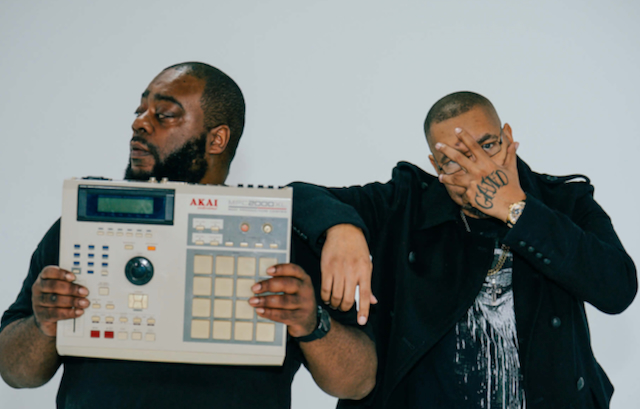
Emcee Precyce Politix and producer D.R.U.G.S. Beats have released a series of concept albums chronicling the life of a young man in the streets and the ultimate cost of crime. The series is called DRUG-Politix and the latest chapter in the story is titled DRUG-Politix 3: The Agony of Victory.
The Agony of Victory is a 16-track album produced entirely by D.R.U.G.S. Beats. The project features appearances by Mallz, K-Hill, and V8ga.
The Real Hip-Hop talked to Precyce Politix about his relationship with God, why he no longer curses in his music, working with D.R.U.G.S Beats, and their new album, DRUG-Politix 3: The Agony of Victory.
TRHH: Why’d you call the new album The Agony of Victory?
Precyce Politix: I called the new DRUG-Politix album The Agony of Victory because it’s the third installment of the trilogy and the protagonist has gone through so much that when you get to a place where you’re finally at peace, and you get to a place where you finally understand that you have to do something better for me and my son, me and my family, that’s a victory, but it took a lot of agony to get there. Nobody leaves a situation until it gets too hard, or until it gets too dangerous, or until they’ve been through a lot of pain.
So, it took that pain and that agony of the protagonist — he lost his mother, he had a situation where there were two attempts on his life, he lost his significant other. I mean, there was just so many things that happened to him. His brother got locked up and he just decided, “You know what? This is it for me. I gotta get out of this.” And he got out of it alive, not unscathed, but alive. That’s a victory in itself. But he had to go through a lot of pain and agony to get there. And then he let God move into his life, and that’s the ultimate victory. So that’s why I called it The Agony of Victory.
TRHH: How much does this story mirror your life?
Precyce Politix: Too much, actually [laughs]. When you take a song like “Accountability” I’m talking directly about me and my son’s mother, Lena. And no name, no blame. I did what I did as far as the street stuff and everything that I’ve been talking about. But it went a little bit different for me because I got out of it because of my son, and the protagonist gets out of it because of his son as well. But there were other factors, like big bro getting locked up, which was on the first album that started out with big bro getting him into the game. Which, like I said, a lot of this reflects my real life and what I’ve been through. I mean, you can hear it in my speech, you can hear it when I’m rapping. You can see it the way that I paint the pictures. I mean, there’s a difference between painting a picture or telling a story from the side of a spectator versus from someone who’s really in it and someone who’s really been through it. And if you’re sharp enough, you can catch the difference. You can catch the holes.
So, a lot of it does reflect my life, especially the part about letting God in finally. With the message that I was trying to make for DRUG-Politix, the whole thing is, believe it or not, it’s an anti-drug message. A lot of rappers, they glorify it. They talk about the women and the cars and, the respect and all of that, but they don’t really talk about things like the PTSD and how that PTSD can destroy homes and break apart families. They don’t talk about seeing things that you really shouldn’t see and participating in things that when you think about it, it really kind of haunts you.
I mean, I have stories that I can’t put on wax. I have stories that I can’t really tell anybody, or the only person I’ve told was my therapist. I mean, this is the other side of that. It’s not always, “Oh, I retired. Gangsters don’t die, they get chubby and move to Miami.” It’s not always like that. You don’t always end up in Miami. Sometimes you end up right where you at if you’re lucky. You end up cleaning your life up and the money ain’t as fast as it used to be for the protagonist, but it’s all good because, hey, at least he got out of it and at least he’s finally free. You know? So, it mirrors my life. It mirrors my life a lot. But I’m proud to be here. And the mistakes I’ve made in the past, I’ve made them. And now I’m here, and this is my victory. This is my victory lap.
TRHH: How has the chemistry between you and D.R.U.G.S. Beats evolved over the years?
Precyce Politix: Just becoming sharper — both ends. D.R.U.G.S. is a phenomenal producer. If anybody knows me and they follow me, they know that I always give respect to the producer, whether it’s D.R.U.G.S. Beats, or K-Hill with Stallone & Weathers, or Sharp Cuts with the Bash Brothers, or my man Trblmker from New York. Whenever I do records, I always make sure that people understand that the producer is a huge part of it. Not just a credit, you know. The chemistry with D.R.U.G.S. and I, we continue to just evolve. We were in car accident together, everybody remembers that, and we were close before then, but then after then we even got closer. And it’s definitely a great relationship that keeps me sharp, because of course he’s Grammy nominated, so he’s gonna do what he does. And he’s gonna do his numbers.
I have to make sure that I bring things to the table that complements his beats. And when I sent him everything back for the project and he was listening to ‘em, and he added things here and there as far as putting things in the beat that would make my voice pop more, that would make my story sound even better, he just tightened up the canvas. Our chemistry, you hear it on the album. I mean, we’ve always had dope chemistry, but it just keeps getting better and better as we both mature. Mainly me as I mature with my pen and my writing. So, it just keeps getting better and better.
TRHH: “Pardon Self” has a sound in it that sounds like singing. It sounds very pleasant, yet you told sort of a violent story on it. Why’d you decide to approach that beat in that way?
Precyce Politix: I like the singing in the background. I like that. And so, I was like, “Well, this is a song that I would like to tell a story on. What type of story do I want to tell? I want to tell a story that it seems like it’s kind of violent, but when you listen to it, it’s another way for me to show that God is moving into the protagonist’s life.” It also shows that God’s always been there to get him out of things. First eight bars tells you that. It’s like, “Some call me God, some call me superstition, others call me Juju.” So, I mean, that’s why I chose that. That beat just spoke to me. I was like, “This is something that I wouldn’t normally write to, but I really love the beat.” I really love the drum pattern and I love the singing in the background.
So, I was like, “So, how can I teach a lesson? How can I show that God moved into the protagonist’s life? How can I show that God moved into my life?” I gotta have a situation where God walks up to him and tells him, “Hey, this is what’s happening. Now, if you can choose to believe in me, and you can take what I’m saying, take my advice. Or you can just keep drifting along and watch what’s gonna happen to you.” So, an attempt was made on the protagonist’s life on the train, and that’s what happened. And I just felt like that beat just spoke to me, and I just wanted to rhyme on it like that. It wasn’t a normal beat, so, I wanted to tell a story, but I wanted it to be one of those stories that makes you think. Like really makes you think like, “Oh, wow. OK, so, I see what happened.”
That’s why I approached that beat that way. D.R.U.G.S., the way he makes beats, it challenges me. I’m not gonna say anybody, but most producers make boom bap beats, right? They’re just boom bap and you get on there and you can you do your 1-2 and then you keep it moving. But with D.R.U.G.S., he will send you those type of beats, but then he also sends me special beats. Those beats where he kind of makes those beats just for him, but he sends them to me just to see what I would do with them. A good example of that would be that song “Anything” from DRUG-Politix Part 2. Just beats that challenge me and challenge me to think differently. And so, this was one of those beats, so, that’s why I approached it that way. It sounds violent, but it’s really all about God moving into my life and showing me, “Hey, look, I’m here. I’ve always been here with you. Now I really need you to listen to me. Because I’ve saved your life many times, but you’re still skeptical. So, let me save your life one more time. And let me show you what it is.” So that’s what that’s about.
TRHH: What’s your relationship like with God?
Precyce Politix: I am definitely a work in progress. Absolutely a work in progress, heavy believer. I know that God looks after children and fools, because I’ve been both on many different occasions at many different ages. So, I know for a fact that God has looked out for me and I’m grateful. I have my son who is my everything. I got a chance to be a father and to be a present father. I got a chance to homeschool my son. A lot of fathers, especially black fathers, who’ve been where I’ve been, they can’t say what I’m saying right now. So, I know for a fact that God really looked out for me. And am I worthy of it? No. But, I’m thankful. I’m very thankful that he chose me.
He chose to spare my life, and I think he’s sparing my life for something greater. My relationship with God is also changing the way I write, too. If I didn’t have the relationship that I have with God, I wouldn’t have been able to write The Agony of Victory. I took what you said to heart last interview. There’s absolutely no cursing from me on the album. Now, Mallz did drop one or two. That was Mallz. But that’s cool because I’m not going to tell a grown man how to write. And I also want to show people that I can still bang out with the best of them, whether they choose to curse or not. That’s not going to influence me because I know what I want to do.
And I felt like with this type of message I wanted to deliver it the best way I could, so, I decided to not curse. And I’m deciding to not curse anymore in my rhymes if I can help it. I just want to be able to flex the vocabulary, and show the real skill, and deliver my message as best as I can. Because my son is starting to pay attention to my lyrics now. That’s another reason why I decided to just kind of chill out and kind of write a little different. And this album came to me and I was like, “What is going on?”
It’s like God is finding his way into my pen more and more. And I started to kind of feel it with Stallone & Weathers, but I kind of brushed it off. And then now I’m like really accepting it. And I’m like, “Okay, well, whatever happens, happens.” Am I a gospel rapper? Nah, I don’t know what I am [laughs]. I just know that I am extremely blessed. Probably more blessed than I deserve. And I feel like if God has given me this talent, I can at least say something to make at least one person think about him for a few minutes, at least, and then God’ll do the rest.
TRHH: The song “Paranoia” stood out to me for its storytelling. How long does it take you to write a story like that?
Precyce Politix: So, when I do a concept album, and the whole DRUGS-Politix trilogy is a concept, I just write the story out in the beginning before I hear any beats, before I hear anything. I’m like, “What do I want to take place on this album? What do I want to convey?” And then when I have the story down, like the foundation, then I just make songs to fill in those stories. Like, “OK, at this part, I want him to feel like he is pressured. I want him to feel like everything’s coming down on him and he’s getting paranoid.” So, I knew I wanted to have some type of song like that. So, when I heard the beat, I was like, “That’s it.” That piano, that’s it, that’s paranoia. I wrote that in about 45 minutes and I write all my songs in the car. That story took me 45 minutes. “Before the Fall” took me three days. Different moods, I want to put more time into it.
Paranoia was easy, honestly. That was an easy write for me because if you’ve been in that situation or if you’ve been in that arena, for lack of a better term and you know that anything can pop off at any time and you can’t really trust nothing — you can’t trust those that come on the block, especially if they circle the block. That’s why the hook is like, “That’s the second time that car came around.” That’s real stuff that happens. “Shorty popping wheelies on his bike just to warn us.” I mean, yeah, rest in peace to my man Beaver, he used to do that. He’d be riding his bike and if he saw something crazy on the block, like if he saw a car that he might have thought was DT or something, he would pop a wheelie. If he saw a car where it was like a no-name person, somebody that he hasn’t seen before, but then they come around again, he would do a certain jump off the curb. There’s different tricks that he would do.
That was easy for me because I’ve really been in that. So, that was really simple for me to write. And then people are asking me now after they purchased the album, which I’m so grateful for, they’re saying, “Hey, so whatever happened? Who was that dude that pulled up on the block?” I’m like, “That’s the point. You don’t know.” That’s where the paranoia comes from. So, it didn’t take me long to write that one, about 45 minutes, And that’s because the hook came first. And then after the hook, the verses were kind of cake. I mean, sometimes the hook is the hardest part, and sometimes the hook just screams at me when I hear the beat. That was one of the times where I heard the beat and I just started rapping. And when I started rapping, I did that, And that’s where the hook came from. So, it didn’t take me too long to write it, but I’m glad that that stood out to you. That’s one of my favorites.
TRHH: “Safe Travels” is a heartfelt song; is that based on real life?
Precyce Politix: So, I had to take myself back to when my mother was sick with cancer. My mother’s fine now, by the way. She’s in remission, she’s good, enjoying her grandbaby, to God be the glory. But I had to take myself back and it was easy for me to take myself back there, because that was such a crazy part of my life. I tell people, I grew up in New York, but I also grew up in North Carolina too, because that’s when I really started to understand that, “Hey, you know what? My mother’s gonna leave here one day.” And that’s when she was diagnosed with cancer. Her and my father was diagnosed with cancer at the same time. I watched them hold hands in chemotherapy. So, when I tell people I grew up in New York, and I also grew up in North Carolina, I mean that. It’s a heartfelt song. I was able to do that. I was able to write that. I also wanted my mom to hear it, to let her know how much I care about her, because that’s stuff that you say usually when people can’t hear it.
So, I wanted her to get her flowers while she’s still able to smell them. And I also wanted to make a moment on the album where it’s like, if this don’t change you, nothing will. I’m conveying the guilt that I felt. I’m like, all the time, me chasing this money, and then my mother’s sick, and now I’m about to lose her. And now I’m thinking about all the time that I could have spent with her instead of running the streets and doing what I had to do, thinking that the money that I was chasing was the most important thing. So, that shows you that time is the most important thing because you can’t get that back. And then, she’s close to God and she’s talking to me about God — another instance where God is really starting to move into the protagonist’s life. I have to do that. I have to show those things because if you just hear the good parts about things, that’s easy to do. But when you write about stuff like that, that really changes you, that kind of helps people relate more.
I almost didn’t put that on the album because I’ve had a lot of friends that lost their mothers recently, but I wanted to go ahead and do that at least for my mom. All of them reached out to me and they’re like, “Yo, that song makes me cry so much. Thank you for writing that, that’s really dope.” I think that’s the highest compliment you can get as a writer and as an artist. I mean, yeah, you can tell me it’s dope all day, but if it moves you to tears or if it moves you to feel an emotion, that’s like the highest compliment you can get because that means that I wrote that well.
TRHH: Who is The Agony of Victory album made for?
Precyce Politix: The Agony of Victory album is made for, of course the fans of Precyce Politix and the fans of D.R.U.G.S. Beats. Our fans grew along with us, or I would like to say that I grew up along with my fans, because we’ve all grown up. The fans that used to hear cyce back in the day versus the cyce now, I mean, we’ve all grown up, right? This album, hopefully someone will hear it that’s at that crossroads and maybe they’ll hear it and say, “You know what? Maybe I shouldn’t do that. Maybe I should chill. Maybe I should stay on the straight and narrow, because a lot of this happened to this person and he changed his life. Maybe I can change mine too. Or maybe I don’t have to go down that route because that route sounds pretty unpleasant.” Especially those that go back and listen to part one and part two, mainly part one. And they’ll see where I came from with part three, with The Agony of Victory. So, I wanna say that the album is made for not just Hip-Hop heads, but to those who appreciate music and appreciate good storytelling in general. I could easily say, “Oh, it’s for all my heads,” and all of that. Nah, I mean, maybe the younger me would have said that.
I can’t explain why this album is so special. And I know that that sounds bad because I wrote it, but this album just feels really special to me. And I’m super proud of this album. Like I’ve never been more proud of an album than I’ve been of any other album. Like, I’m super proud of this album. My last album I did before that, The Great and Terrible, I did it, printed it, hated it. That’s how I knew I was changing too. I was like, “OK, well, I did it, I’m putting it out there, but I don’t know.” There’s some joints on there, but in my new direction, nah. So, this album is for everybody, especially those who have lost someone important, or those that are going through a rough time in their lives where they’re trying to make a decision and they’re trying to make sure, like, “OK, should I jump into this game to get this fast money? Or should I just stay on the straight and narrow and keep my faith up?” That’s who this album is for.
Purchase: Precyce Politix & D.R.U.G.S. Beats – DRUG-Politix 3: The Agony of Victory
Like and subscribe to the podcast on Spotify and Apple Podcasts.
Emcee Abitight (Appetite) and producer RP are two members of Chicago’s Greenlights Music collective. The…
East Coast emcee Thought Provokah is back with a new album that chronicles his coming…
Like and subscribe to the podcast on Spotify and Apple Podcasts.
Rhinoceros Funk (emcee), Silent Someone (producer), DJ JS-1 (DJ) are Silent Funk + 1. Originally…