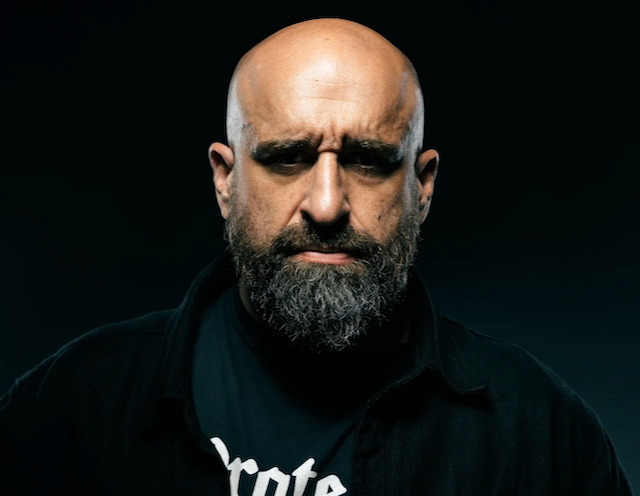
Rhode Island emcee B. Dolan has returned with his fifth solo album called “Fight Naked.” Fight Naked could be used as a metaphor for Dolan’s (and ours) fight with life, death, and the tumultuous times we’re currently living in. Released by his Glaring Typo Record label, Fight Naked is described as a walk “through an underworld of blaring warnings, fascist book-burnings, and planetary upheaval.”
Fight Naked is a 12-track album featuring Curly Castro, Skipp Coon, Nya, DJ Zole, Mithago Craze, and D-Styles. The album is produced by Ant, Small Professor, Controller 7, Widowmaker, and B. Dolan himself.
The Real Hip-Hop spoke to B. Dolan about what he’s doing to help people detained by ICE in Rhode Island, undergoing spinal surgery, and his new album, Fight Naked.
TRHH: Why’d you call the new album Fight Naked?
B. Dolan: It was a thought that occurred to me because I heard somebody somewhere and I really wish I could remember where, somebody somewhere was like, “People who sleep naked what’s your plan if someone breaks into your house?” and immediately my response in my head was, “fight naked.” You have to be prepared to fight naked. So, it was just kind of a thought I had at one time. It’s a different type of fight scenario if you imagine yourself in it [laughs]. It’s about fighting in your most vulnerable place. As just a two-word story it kind of struck me and then honestly I wrote the whole song backwards. That’s the last two words of the song and a lot of the rest of it was setting that up and it just became like a broader concept for the album.
TRHH: It feels like we’re fighting naked right now doesn’t it?
B. Dolan: Yeah, yeah, yeah. This is a good metaphor like, yeah, fight naked. Kind of how like karate comes from “empty hands.” It’s the same idea.
TRHH: The second verse of “Boys To Men” speaks about how boys are socialized not to deal with emotions. You say, “The only thing that’s socially accepted is our rage” and it made me think of how my therapist told me years ago that men are only comfortable showing emotion when they’re fighting or fucking.
B. Dolan: [Laughs] Yeah, yeah.
TRHH: There is also obviously death that men show emotion about. I believe that limiting our emotions is a major reason why men don’t live as long as women. What do you think we can do as a society to change the way we’re raising boys to hide their emotions?
B. Dolan: It’s interesting. I think people gotta learn about the idea of patriarchy and what it means and how it affects men and women. If I had one wish it would be to just increase the baseline knowledge of what that idea means. Patriarchy — that old idea we inherited from our parents. Across cultures, around the world this idea that men should dominate and women should be subservient, and how that affects men and women. It messes everybody up equally and if you start talking about it, people have a resistance to the idea of feminism or feminist ideas, because they think that it’s only about women or that’s something that’s going to be harmful to men or anti-man. They don’t really realize that feminists for a really long time have been trying to liberate men and women from these standards, these ideas. and expectations. They are as harmful to men as they are to women. They end us up like the song says “in hospital beds or dead.” We see the results of it all around us – all the way up from our families to our government.
TRHH: On the song “The Bends” you have a lyric where you say, “I create all this anger, feel like I’m drowning in it.” Explain that line.
B. Dolan: Ah man, that was just a very honest moment that song. I just kind of spilled out a lot of confessional stuff the way it worked out. I don’t even think I understood the roots of a lot of my anger at the time. I just experience myself as a tense person, as a person who is on edge, paranoid, hyper-vigilant. You sometimes accept these ways of being and don’t realize how they’re affecting you over time. When you dig into why, you get to things like trauma. So, I’ve been exploring all that myself these past couple years.
I have CPTSD, and not a little bit of it, like a lot of it [laughs]. Even my laughing response as I say that is part of it. I tend to say horrible things and then laugh. Figuring out and learning about all that has been the personal work I’ve been doing as I’ve gotten older. As my body has aged, as I’m newly disabled. I got a metal spine now — that changed a lot of things. I don’t know if you know that about me.
TRHH: No.
B. Dolan: Yeah, 2019 that’s what ended my touring career basically. During the pandemic I realized that for three to five years I had been touring with collapsed vertebrae in my neck. I needed an emergency surgery during lockdown, no visitors in the hospital. A large portion of my spine is metal now, so I’ve had to adapt to ongoing neuromuscular stuff as a result of that. That was a big shift for me in physically realizing that I had just been going so hard for so long. I was touring with collapsed vertebrae in my neck, just hauling boxes and drum sets and shit, picking people up on stage by their collar. It’s a new phase of life for me at this point, so I’m just checking it out.
TRHH: How’d you injure your neck?
B. Dolan: They say it was possibly half genetically predisposed. There’s a lot of bad backs and slipped discs in my family. Living on the road for close to 20 years, 2005 to 2019, was a hell of a physical experience and toll. I didn’t start learning about shit like yoga and all that. I was just a big dude my whole life, working class background, my dad was a big dude. I was hauling trees and shit on my back and helping my uncle landscape when I was 12, just picking heavy shit up my whole life. I think some combination of that.
TRHH: How’d you discover it?
B. Dolan: The only symptom was numbness in three fingers on my left hand. We were touring on the Epic Beard Men tour and I was driving and I was like, “Oh, that’s weird.” They treated it for eight months as an ulnar nerve entrapment, which is what they thought it was. And then the pandemic happened and I stopped going to PT and I still had this thing. My wife was like, “You should get an MRI. That’s weird that it’s been this long.” It’s been eight months trying to treat it and when I got the MRI they were like, “Stop taking any medicine, we need to operate immediately, don’t get rear-ended, you’re very close to neck down paralysis if you sustain any injuries to that area.” Basically, my body had just kind of been going. They said people with MRI’s that look this can’t walk up stairs. I’d been touring like that for three to five years.
TRHH: Crazy. So, how do you feel now?
B. Dolan: Good. I did tour post-surgery but the U.S. was just so big and crazy, and then the markets state to state, the deals were weird. It was too physically punishing and I just pretty much needed to shift my whole way of doing things to subscription-based stuff, more online offerings, working directly with fans, took control of my own masters, opened my own label. So, getting more things under my control and then just kind of figuring out how to spread the music without touring and sustain myself here, while being able to keep working on music is good. I just built a shed in the backyard and fitted it out like a studio during the pandemic. I just worked streaming shit from there and in between time I’m doing yoga classes, strength training, and all this shit my PT says I need to do to sustain my current status. It’s ongoing — aging like everybody.
TRHH: Speaking of which, the song “Fifty Five” is a sobering song. I unfortunately can relate to it. How did you cope after losing your dad and did experiencing this make you concerned about your own mortality?
B. Dolan: Yeah, at the time it did. I remember it definitely did at the time, because when your dad dies as his only son it’s very much like you feel something passed to you, like you’re next, it’s on your head now. I think honestly the way I dealt with it was unhealthy for a long time. I think I did what a lot of people in that position would probably do, which is to try and assume all the responsibility from the person who’s died, to take over who they are to the family, and all their responsibilities become your responsibilities type thing, and kind of push myself and numb myself.
I think I did that for a long time. That’s honestly how I coped [laughs]. I just started smoking weed all the time, and touring like a fucking lunatic, and trying to keep all the plates spinning, and handle all the family responsibilities, and do all the stuff, which takes a toll. You realize that a certain point you can’t be the person that’s gone. Certain stuff is just gonna be what it is, and you can do what you can do, and you gotta figure out grief and all that on your own time. It’s a complicated answer. I coped in a lot of ways.
TRHH: I was just thinking about my dad who was 57 when he died. I had this burst of, “I’m going to enjoy life because this shit is too short!” I was doing everything that I’d never done before, but I wasn’t dealing with it. A few months later it just hit me and I was out, bro. I developed panic attacks. It was just bad, man. I got put on medication, it was really bad. You’re never really the same after losing your dad.
B. Dolan: Yeah.
TRHH: It’s tough, man. That’s why I asked how you coped because I’m interested to know how other people deal because I don’t think I did.
B. Dolan: It’s hard, man, and it’s ongoing, too. With a parent specifically, it’s a level of closeness that they sort of are never gone in one way, because it’s like as you age you will always see them. I have siblings who have kids now and it’s like, I interact with my dad every time I interact with one of my nephew’s certain behavior. Life as it just continues will continually bring you back to that absence, which is hard. In my case things are were unsaid, things are unresolved in ways that there’s no closure, even sometimes to be very angry at someone who’s dead, or to be very happy with someone who’s dead.
Grief is everything, man, it’s so ill. Even Alias who passed a while ago, he’s a dude that if I listen to records and hear a break I still talk to him. He’s just a kind of a permanent fixture in my psyche or something. There’s happiness in that grief — I have laughs with a dude who’s been dead for five years. Shit’s crazy [laughs]. You’d never imagine. You can’t understand it until you’re on the other side of it.
TRHH: On the song “How I(CE) Could Just Kill A Man” you say, “far more in common with the ones you’re harming” and it’s so true. I know some ICE agents are having a blast terrorizing brown people, and some are struggling with what they’re doing. What do you think makes the ones who aren’t necessarily Nazi’s continue to comply with these orders?
B. Dolan: I don’t know. That’s the question. At this point, it’s the cliché of whatever you’re doing right now is what you would be doing during World War II, or any of these historical periods, during slavery. If you ever wonder what you would be doing the answer is what you’re doing right now, and in the case of an ICE agent and it’s like, look at you. I guess how hard do you have to work to avoid that look in the mirror to realize, “Oh, I’m a slave catcher, I’m a Nazi, I’m a Gestapo. I’m all the worst bad guys of history. I’m now in this role carrying out the worst abuse and violence, and targeting the most vulnerable people.”
I don’t know, man. I don’t know how they wake up, I don’t know how they look in the mirror. I guess just the most toxic, uninformed communities can produce that. There’s all sorts of ways that people get led into this fucked up cult that’s going on. I guess the ignorance has a lot to do with it, insecurity, I don’t know, man. It trips me out to even look at someone in that role. Or just pure, “I want the $50,000 bonus, I don’t give a fuck who gets hurt.” There is that level of narcissism, but that’s the cult shit, too. That’s its own kind of cult.
TRHH: All of the proceeds from the purchase of “How I(CE) Could Just Kill A Man” go to a good cause. Please tell the people about AMOR.
B. Dolan: They’re in Rhode Island. They’ve been here for years. They just had their 13th anniversary. They are entirely led by women of color, and non-binary people of color, from the most affected neighborhoods in Rhode Island where I live. So, ICE has been scooping up people here at the courthouses for over a year now. It was last June that I started to see the calls from the AMOR Network for people to come out and be part of the defense line. The same thing Renée Good was doing when she was murdered. I’ve been doing that since June and then I attended a Zoom presentation that they were giving about the Wyatt Detention Center, which houses ICE detainees in Rhode Island, and it’s the only place in Rhode Island that ICE can house detainees. They’ve been trying to get that place closed since 2008. I’ve been signing petitions, but they’ve been actively dealing with it.
So, it was kind of like a catch-up history of the Wyatt and then they hit me up and asked me if I would be part of their legislation group. And again, because I’m shifting everything from I’m not touring anymore, so I’ve never really had this opportunity to go work for an organization I believe in. I have sent them money with singles and stuff, but I’ve always been on tour. I’m in this new time in life where I can do shit that’s value-based where I live. I’ve gotten involved and it’s usually once or twice a week. Now we’re at the statehouse. I gave testimony to the House Judiciary Committee, I’m chasing down politicians in the State House trying to get ICE out of this detention center. Currently, that’s the bill we’re working on. But yeah, they’re dope. They provide mutual aid to immigrant families who have someone locked up or who gets scooped up, legal help, the defense line, a legislative team, and community outreach to prisoners as well.
TRHH: What do you want people to take away from Fight Naked?
B. Dolan: How it’s a good album. I made it without too much consideration. It was the first record I made where I wasn’t anticipating touring it, and I really just kind of locked myself in the studio and did what I wanted to do. So, I’m very proud of it. I always feel this way [laughs]. I think it’s my best record — I hope it’s my best record. I think I’m still getting better. For me it’s a capsule of time and things I was thinking about and feeling inside. I never really have too much expectations of what people would take away from it, or what it’s going to do, or what effect it’s going to have. I’m more just surprised by that. I hope it’s a good album. I hope people connect with it.
Purchase: B. Dolan – Fight Naked
Emcee Precyce Politix and producer D.R.U.G.S. Beats have released a series of concept albums chronicling…
Like and subscribe to the podcast on Spotify and Apple Podcasts.
Emcee Abitight (Appetite) and producer RP are two members of Chicago’s Greenlights Music collective. The…
East Coast emcee Thought Provokah is back with a new album that chronicles his coming…
Like and subscribe to the podcast on Spotify and Apple Podcasts.