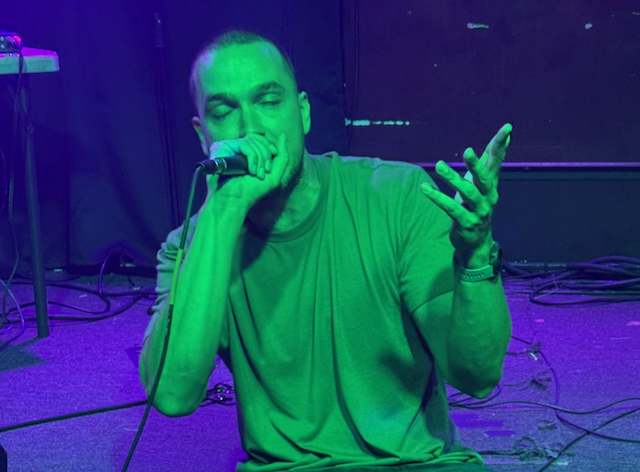
Emcee/producer Ronesh’s latest album is a journey into the realities of adulthood for many. On “You Say Compartmentalize Like It’s A Bad Thing” Ronesh touches on dealing with divorce, job loss, and mental health issues, while also enjoying fatherhood and being in gratitude with his place in life.
You Say Compartmentalize Like It’s A Bad Thing is an 8-track album written, produced, mixed, and mastered by Ronesh. The project features appearances by Angelenah and Doc Wattson of Greenlights Music.
Ronesh talked to The Real Hip-Hop about finding a balance between working and relaxing, why some middle-class American’s bow down to an oligarch, and his new album, You Say Compartmentalize Like It’s A Bad Thing.
TRHH: Explain the title of the new album, You Say Compartmentalize Like It’s A Bad Thing.
Ronesh: [Laughs] Yeah, so it’s kind of a long title. It’s one that doesn’t necessarily just roll off the tongue, but it was something that came up to me when I was actually in a session with my therapist. I don’t think it’s something I actually said out loud, but I thought to myself. Because my therapist was saying, “I think you have this tendency to compartmentalize your feelings,” and she ain’t wrong. From some further sessions exploring that idea a little bit I don’t think it is necessarily a bad thing, I don’t think it’s a good thing, I think it can be either. When I say “compartmentalize” it’s like if there is a certain experience, or feeling, or emotion that feels extremely negative to me my tendency is to try to just move that really far out of the way so I can continue to do the things I need to do. I think it’s not always a bad thing, because that does enable the day-to-day work and necessary tasks of life to get done without being overwhelmed by the negativity.
But you can’t just push it all the way out of the way and expect it to not come back. You can’t bottle shit up forever and take it to the grave or people have physical disease from stress and holding on to feelings. So, I think for me it was a little bit like self-deprecating — just something that I catch myself doing, but also like exploring that balance between organizing different feelings and thoughts as needed, but without just denying their existence or refusing to process them. I think you hear throughout the album a lot of different emotions and in a lot of ways making music is probably my way of confronting a lot more of these negative emotions and thoughts. It’s easier for me to do when I’m writing a song than it is in a conversation with a friend or even journaling to myself if I’m not writing a song. It’s hard for me to be as fully honest as I am when I’m making music.
TRHH: I think there’s a book called “Women are Spaghetti and Men are Waffles” or something like that. I’ve never read it, but I think the premise is men are like the little squares in the waffles — we compartmentalize things, but women are like spaghetti, everything is all together. I think this is just a guy thing?
Ronesh: I don’t want to make a broad generalization, but I would say that pattern is something that probably commonly does show up along gender lines. I mean, we don’t really have a blueprint for dealing with emotions in healthy ways. You and me having a conversation like this, it’s kind of uncharted for a lot of men. I’m with the millennial generation, I believe you’re Gen. X, is that right?
TRHH: Yeah.
Ronesh: So we’re probably really the first ones that are openly talking about a lot of this. So, it’s messy, it’s chaotic, we’re figuring it out as we go. Things don’t always fit in neat little boxes despite how we might want them to. So, dealing with that tension is something we’re all figuring out.
TRHH: On the song “Back To The Ground” you talk about being pulled between relaxing and working. This is something that I’ve struggled with myself. I feel like I always need to be doing something. Have you been able to find a balance?
Ronesh: It’s difficult because I think I’m always thinking about what actions can I take in a given day to get to where I want to be. And when I think about it logically it’s like, OK, I need to practice this and this skill, learn this and this thing to further my career. Or maybe it’s take care of my house, my finances, sign my kid up for these activities, something. I’m losing ground if I’m not doing that, but then the reality of it is like rest is important, too.
You gotta recharge and again exploring trying to find that balance and kind of learning to trust myself when I feel like I need to rest. I can probably listen to my body and do that. If I feel like I really haven’t been working hard enough, there’s probably some truth to that, too. That happens, I get lazy. I’m not necessarily where I would like to be in a lot of ways, but at the same time just grind, grind, grind isn’t the best healthy way to get there.
TRHH: It’s interesting to me that the album is in chronological order and “Be Alright” comes right after “Back To The Ground.” How were you able to find optimism so soon after writing Back To The Ground?
Ronesh: Yes. Funny thing, I was telling my friend this the other day as we were listening to the album, so Be Alright is after Back To The Ground and before a song called “Sad Raps.” I really feel like it was me trying to convince myself that we’re gonna be all right, I’m gonna be all right. And not to say that it was false or that I was lying to myself, because as I was going through various personal and professional struggles putting together this album there was still a lot of good going on in my life. So, after Back To The Ground I felt like I needed to write something to remind myself of the various things I have to be grateful for. I didn’t know how much worse things would get a few months later.
I still had basically had my dream job while I was writing the first three songs of that album, and then I got laid off. Looking back on it I’m like, “What was I even going through then?” It just goes to show that what people see at the surface level doesn’t always reflect what’s going on internally. I find optimism in watching my child grow, I still have some really good friendships. I don’t see my friends in person nearly as much as I’d like to, largely because most of us live in different cities. But I do have solid friends, some solid family members that I’m really grateful for. I still have my physical health to a reasonable degree and even in the midst of various difficulties it’s important to remind ourselves of what we are grateful for. I think that is what I was trying to express with that song.
TRHH: I like the horns on the song “Questions.” Are the horns sampled or is that a keyboard sound?
Ronesh: I sampled that. I don’t remember off the top of my head where that sample came from, but I did sample the horn and put a lot of distortion on the sample, as well as the drums, and on my voice on that song in order to sort of represent the chaotic feeling that I was going through when I was writing that.
TRHH: On “Questions” you say, “How do I stay optimistic when honest reflection turns me to a pessimist?” That really hit home with me. Have you found the answer to that question?
Ronesh: [Laughs] It’s hard, man. I mean, we are bombarded with negativity. Pretty much you log in to any social media app and the worst stories are the ones that make the most noise. I want to say these algorithms are financially encouraged to show us things that get us to react, and so there’s something that’s called “rage bait” now which is people posting very inflammatory things that they don’t even necessarily believe. This is the stuff that ends up being shown to us more and that’s just in the social media world on top of the fact that we’re basically in World War III right now. So, how do I stay optimistic when honest reflection turns me into a pessimist? I don’t know, man. I mean, I don’t know if I do stay optimistic. I try to not just be doom and gloom all the time. I feel like I don’t really have a choice.
I’m very motivated by being able to show up for my child. She’s four years old now and completely insulated from a lot of the ways of the world still. I know that I can’t protect that forever. I don’t know if I stay optimistic but I can’t give up on life, on humanity. I see good in people everywhere I go, despite the fact that the bad is so prevalent. There’s a lot of good in people. There’s a lot of good even in the United States of America and the people of America, not so much in our political leaders. If you travel around the country even people that had we communicated as strangers on social media we might be screaming at each other, you meet them in person there are a lot of good folks taking care of their family and much less likely to just go straight to aggressive conflict. I don’t know if I have a lot of optimism, because those real human connections seem less and less common. But there’s still good there in us. I can’t give up on that.
TRHH: On the song “Hello New World” you have a lyric questioning how some middle-class people end up kissing the feet of the oligarchy. What’s your opinion on why a country that praises freedom in name has so many people bowing down to a few rich folks?
Ronesh: Yes. Man, that is a big question. I think there’s a lot of indoctrination in very subtle ways — in the way that wealth and poverty are described on the news, and just in our movies and media we consume. Where regular middle class/working class, people are more inclined to blame the person who’s just a couple notches below them on the socioeconomic scale for their problems. I’m sure it goes back further than this, but the example that stands out to me is Ronald Reagan and this whole welfare queen speech he gave in I think like 1980 or something like that.
That was very racially charged of course, too, but I even think this exists even within various races at an economic level. People have really been indoctrinated to believe that they’re struggling because it’s some lazy poor person taking what you worked for. I mean, if you look at how much extreme wealth is being hoarded in the hands of like I don’t know, ten, twenty, a hundred people, it doesn’t even come close. We’re all much closer to being out on the street struggling than we are to being that billionaire. I don’t know why more people don’t see that. I guess it’s easy to find a boogeyman if you can find a way to feel better than them, superior to them.
TRHH: What do you want people to take away from You Say Compartmentalize Like It’s A Bad Thing?
Ronesh: I guess that you never really know what someone’s going through. And being honest in your art or even just in your interactions with the people in your life, that can be healing and liberating. And none of us should be afraid to express the harder things that we go through, we just gotta find healthy ways to do it. Maybe easier said than done. When I was making this album I wasn’t even thinking about putting this music out, actually. Because it’s a level of vulnerability that feels uncomfortable to some degree.
That’s all the more reason I think that I had to put it out. I made a song about going through a divorce and one of my oldest friends messaged me and said, “Hey, I wasn’t ready for that song, but I needed it because I’m going through the exact same thing.” I think that’s very validating artistically and then just like on a human level a reminder that we’re all going through these messy and chaotic experiences, and finding our common humanity in that can be really comforting as well.
Purchase: Ronesh – You Say Compartmentalize Like It’s A Bad Thing
Purchase: Status the Marlboro Man and GreyBeard - Hit the Deck
Emcee Precyce Politix and producer D.R.U.G.S. Beats have released a series of concept albums chronicling…
Like and subscribe to the podcast on Spotify and Apple Podcasts.
Emcee Abitight (Appetite) and producer RP are two members of Chicago’s Greenlights Music collective. The…
East Coast emcee Thought Provokah is back with a new album that chronicles his coming…